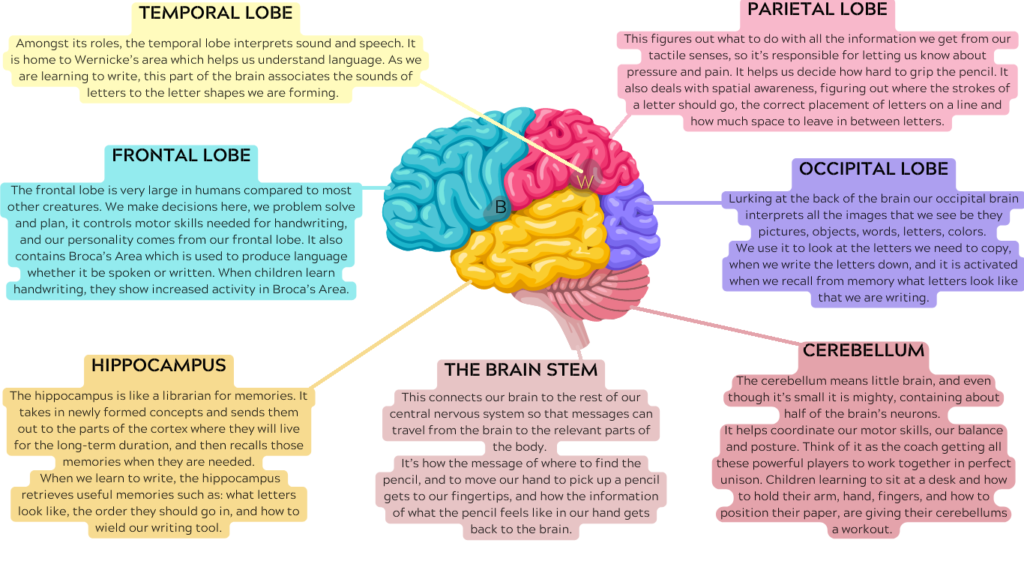
How the Brain Coordinates Handwriting
Handwriting is one of the most neurologically complex skills students learn in school. While it may look simple on the surface, writing a single letter requires multiple areas of the brain to communicate and coordinate in real time.
Understanding how the brain supports handwriting helps explain why writing can be effortful for some students and why explicit instruction in letter formation is so important.
Handwriting Is a Whole-Brain Activity
Handwriting engages far more than the hand and fingers. To write, the brain must integrate visual input, motor planning, sensory feedback, posture, and attention.
These processes occur across multiple brain regions that must work together seamlessly. When any part of this system is underdeveloped or inefficient, handwriting can become slow, inconsistent, or difficult to sustain.
The Role of the Cerebral Cortex
The cerebral cortex is the outer layer of the brain responsible for higher-level functions such as perception, planning, and voluntary movement. It plays a central role in handwriting.
Visual areas of the cortex help recognize letter shapes and spatial relationships on the page. Motor areas plan and execute the movements needed to form letters. Sensory areas provide feedback about pressure, movement, and position.
These systems must operate together to support efficient letter formation.
Motor Planning and Execution
Before a letter is written, the brain creates a motor plan. This plan includes where to start, which strokes to use, and how the letter should be sized and oriented.
Each time a student practices writing, the brain refines these motor plans. With repetition and feedback, movements become smoother and more predictable.
When motor planning is inefficient, students may hesitate, reverse letters, or rely heavily on visual monitoring. This slows writing and increases cognitive load.
Sensory Feedback and Self-Correction
As the hand moves across the page, sensory information flows back to the brain. This feedback helps students adjust pressure, direction, and spacing while writing.
Students who struggle to process sensory feedback may grip the pencil too tightly, press too hard, or fatigue quickly. These challenges can interfere with writing endurance and legibility.
Handwriting, Reading, and the Brain
The brain systems used for handwriting overlap with those used for reading. When students learn to form letters by hand, they strengthen the neural networks that support reading development.
Writing letters helps the brain build stable representations of letter shapes and their associated sounds. These representations make it easier to recognize letters and words during reading.
From Coordination to Automaticity
With intentional practice, handwriting shifts from a highly conscious task to an automatic skill. This transition occurs as motor plans become stored in long-term memory.
Students with automatic handwriting no longer need to devote attention to letter formation. This frees cognitive resources for spelling, sentence construction, and idea development.
Why This Matters for Instruction
Because handwriting depends on the coordination of multiple brain systems, it should be taught explicitly and systematically. Leaving students to “figure it out” places unnecessary demands on developing neural networks.
Effective handwriting instruction supports brain development by helping students build efficient, integrated motor and sensory pathways.
Conclusion
Handwriting is not just a motor task. It is a coordinated brain process that develops through instruction and practice.
When educators understand how the brain supports handwriting, they are better equipped to provide instruction that builds fluency, supports literacy, and reduces unnecessary struggle for students.