
The Science of Reading has brought renewed clarity to how children learn to read and write. Grounded in decades of interdisciplinary research, it emphasizes explicit, systematic instruction in the foundational skills that support literacy.
While phonemic awareness and phonics are often highlighted, handwriting is an essential and sometimes overlooked component of instruction that aligns directly with the Science of Reading framework.
What the Science of Reading Emphasizes
The Science of Reading is not a single program or methodology. It represents a body of research drawn from cognitive science, neuroscience, linguistics, and education.
This research consistently supports instruction that is explicit, cumulative, and systematic, particularly in the early stages of literacy development. Core components include phonemic awareness, phonics, fluency, vocabulary, and comprehension.
Handwriting supports several of these components by strengthening how students learn, process, and recall written language.
Handwriting as a Transcription Skill
Within literacy research, handwriting is categorized as a transcription skill. Transcription includes the ability to produce letters accurately and efficiently so that cognitive resources can be directed toward higher-level language tasks.
When transcription skills are weak, students must devote excessive attention to letter formation. This reduces the working memory available for spelling, sentence construction, and comprehension.
Strong letter formation instruction allows handwriting to become automatic, supporting the broader goals of literacy instruction.
Handwriting and Sound–Symbol Relationships
The Science of Reading emphasizes the importance of connecting sounds to symbols. Handwriting reinforces this connection by pairing letter formation with phoneme instruction.
When students form letters while hearing and producing their associated sounds, they strengthen the neural pathways that support decoding. This multisensory integration helps stabilize letter–sound knowledge.
Research shows that handwriting instruction supports reading development by improving letter recognition, decoding accuracy, and reading fluency.
Why Explicit Handwriting Instruction Matters
Handwriting does not develop naturally through exposure alone. Without explicit instruction, students often invent inefficient letter forms and motor patterns.
These habits can become automated, making later remediation more difficult. Explicit handwriting instruction ensures that students learn consistent starting points, stroke sequences, and letter orientation from the beginning.
This approach aligns with the Science of Reading emphasis on preventing gaps rather than remediating them later.
Handwriting, Cognition, and Learning
Writing by hand supports learning beyond early reading. Handwriting activates brain systems involved in attention, memory, and reasoning.
As handwriting becomes fluent, it no longer competes with thinking. Instead, it supports thinking and learning by freeing cognitive resources for planning, organizing, and expressing ideas.
This is particularly important as students transition from learning to read to reading to learn.
Aligning Handwriting Instruction With Literacy Goals
Science of Reading–aligned handwriting instruction is:
- Explicit and systematic
- Developmentally sequenced
- Integrated with phonics and language instruction
- Focused on accuracy before speed
When handwriting instruction follows these principles, it strengthens literacy outcomes rather than competing for instructional time.
Conclusion
Handwriting instruction is not sepa
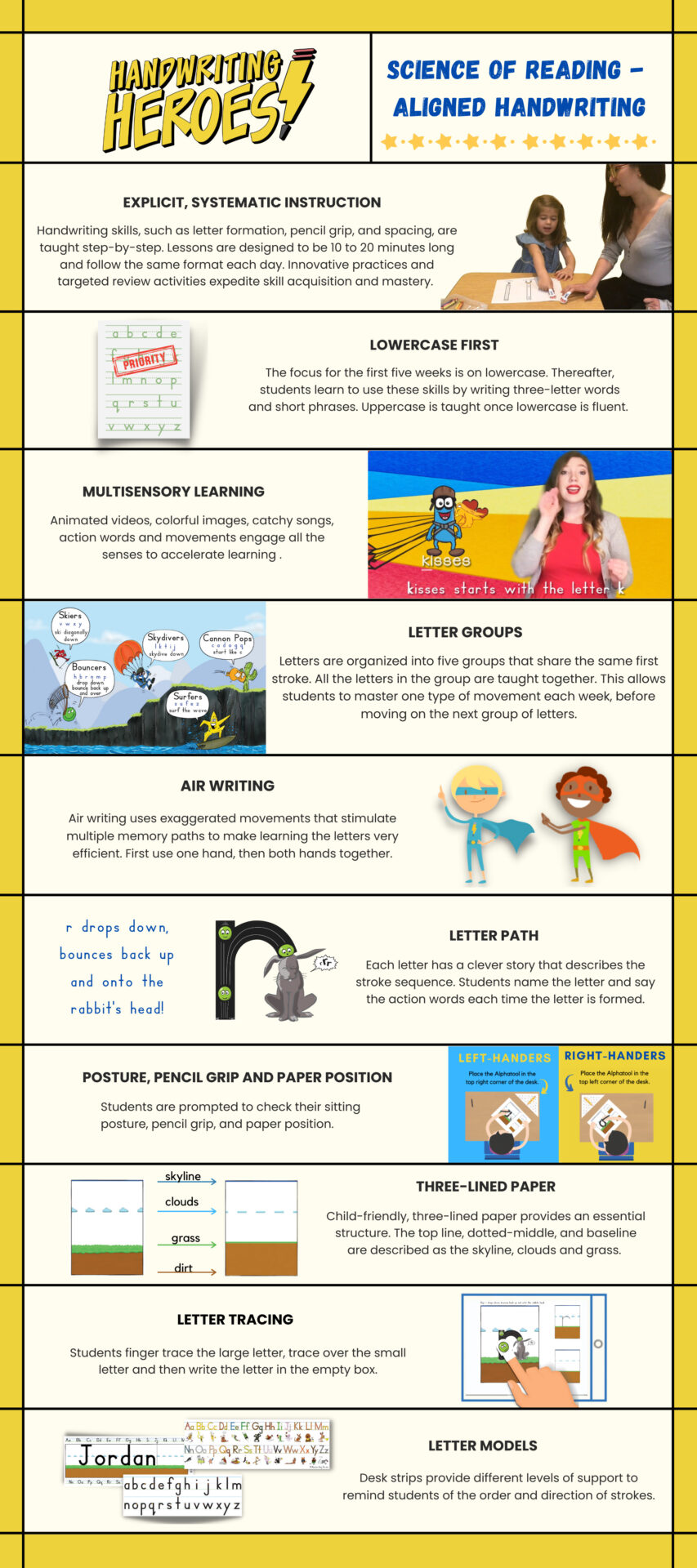
In light of this information, I am proud to reflect on Mrs. Bozarth’s statement that ‘Handwriting Heroes goes hand in hand with the Simple View of Writing presented in our LETRS training. It meets all the criteria.’ The Washington County School District is presently in their second year of using the Handwriting Heroes program with great success. The growing support for the science of reading movement gives me hope that handwriting will be recognized as a fundamental skill that should be taught systematically and explicitly in all classrooms.