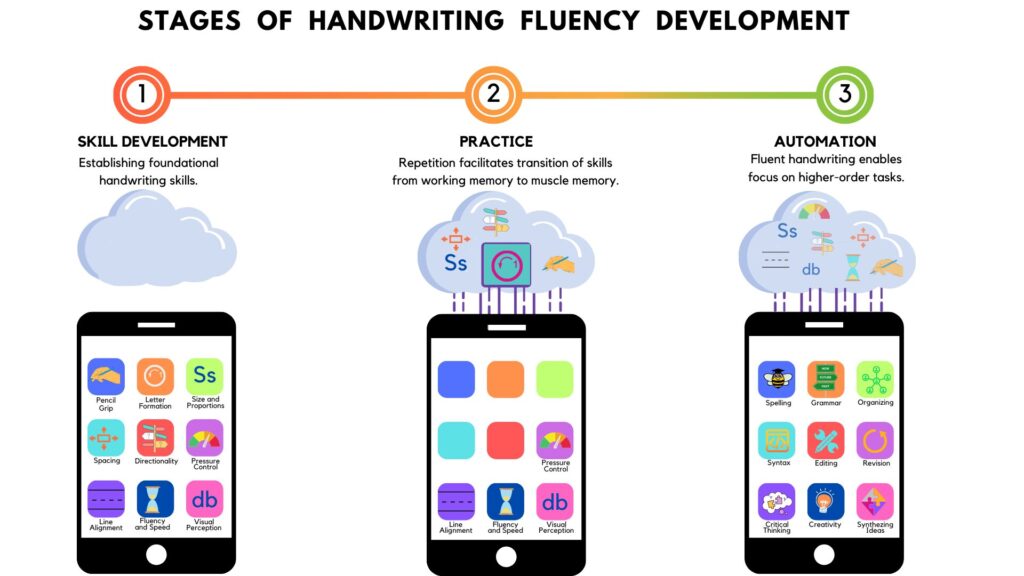
Handwriting fluency plays a critical role in how students think, learn, and express ideas in writing. When handwriting is slow or effortful, it consumes cognitive resources that are needed for spelling, sentence construction, and idea generation.
Fluency is not about neatness alone. It reflects the degree to which letter formation has become automatic, efficient, and reliable. When handwriting reaches this level, students are able to engage more fully in higher-level thinking tasks.
Why Fluency Matters More Than Speed
Fluency is often misunderstood as writing quickly. In reality, fluency refers to the ability to write accurately with minimal effort. Speed is a byproduct of fluency, not its defining feature.
Students who lack fluency may write slowly, fatigue easily, or avoid writing tasks altogether. More importantly, they must devote significant working memory to the mechanics of writing, leaving fewer cognitive resources available for composing text.
Research on efficient letter formation shows that when handwriting mechanics are not automatic, higher-level writing skills are compromised.
Cognitive Load and Writing Development
Working memory has a limited capacity. When students are focused on how to form letters, that capacity is quickly consumed.
This overload interferes with the ability to plan sentences, retrieve spelling patterns, and organize ideas. Students may know what they want to say, but struggle to get those thoughts onto paper.
As handwriting becomes more fluent, the cognitive load associated with letter production decreases. This shift allows students to allocate attention to meaning, structure, and communication.
From Practice to Fluency
Fluency develops through intentional, well-designed practice. Repetition alone is not sufficient.
Research shows that varied practice strengthens motor learning by requiring the brain to actively retrieve and refine movement patterns. This leads to more flexible and durable skill development than rote drills.
When practice includes variation while maintaining consistent formation rules, students develop stronger motor plans that transfer more effectively to authentic writing tasks.
Automaticity Unlocks Higher-Level Thinking
Automaticity is reached when letter formation requires little conscious attention. At this stage, handwriting no longer competes with thinking.
Students with automatic handwriting are better able to focus on spelling, grammar, sentence flow, and idea development. Writing becomes a tool for thinking rather than a barrier.
This shift is especially important as academic demands increase and students are expected to write longer, more complex responses.
Instructional Implications
Supporting handwriting fluency requires more than increasing writing volume. Instruction should prioritize:
- Explicit teaching of letter formation
- Developmentally sequenced practice
- Opportunities for varied, meaningful writing
- Short, focused practice sessions that build endurance gradually
When these elements are in place, students are more likely to develop fluent handwriting that supports learning across subjects.
Conclusion
Handwriting fluency is a gateway to higher-level thinking. When students no longer have to think about how to write letters, they are free to think about what they want to say.
By prioritizing fluency through intentional instruction and practice, educators support not only better handwriting, but stronger writing, deeper thinking, and greater academic confidence.