
Handwriting practice has traditionally relied on repetition. Students are often asked to write the same letter over and over with the expectation that repetition alone will lead to fluency. While repetition plays a role in learning motor skills, research shows that how students practice matters just as much as how often they practice.
Varied practice, which introduces small, meaningful changes during practice, has been shown to produce stronger, more flexible motor learning. In handwriting instruction, this approach supports faster fluency development and more durable letter formation skills.
The Limits of Rote Repetition
Simple repetition assumes that repeating the same movement strengthens motor memory automatically. In reality, repeating a task without variation often leads to shallow learning. Students may appear successful during practice but struggle to transfer those skills to real writing tasks.
Excessive repetition can also contribute to fatigue and disengagement. When attention decreases, the quality of practice declines, limiting the brain’s ability to form strong, adaptable motor patterns.
An Example of Repetition Fatigue
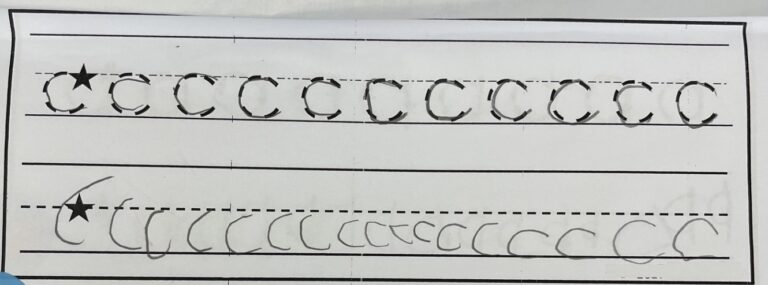
The example below highlights how repetition fatigue can affect performance, even when a student has adequate visual-motor skills.
In this case, a kindergarten student was able to accurately trace letters, demonstrating sufficient visual-motor integration. However, after 17 attempts at independently writing the letter c, none of the productions met criteria for correct form and placement on the writing line.
This pattern illustrates how excessive repetition can degrade performance rather than strengthen it, particularly when practice lacks variation or meaningful engagement.
How Varied Practice Strengthens Motor Learning
Varied practice requires the brain to actively reconstruct motor plans rather than relying on automatic repetition. This increased cognitive engagement leads to stronger memory encoding and more flexible skill use.
In handwriting, variation may include practicing letters within a group, changing writing size or context, or alternating between similar letter forms. These small shifts challenge students to refine motor control while reinforcing consistent stroke patterns.
This approach aligns with research on effective letter formation instruction, which emphasizes meaningful practice over volume alone.
Varied Practice and Handwriting Fluency
Handwriting fluency depends on the ability to produce letters quickly, accurately, and with minimal effort. Varied practice supports fluency by strengthening motor pathways in a way that transfers to real writing tasks.
Students who engage in varied practice develop more adaptable motor plans, allowing them to maintain handwriting fluency across different writing demands, including longer assignments and timed tasks.
From Practice to Automaticity
The ultimate goal of handwriting instruction is automaticity. When letter formation becomes automatic, students no longer need to devote working memory to how letters are formed.
Varied practice accelerates the development of automatic handwriting skills by requiring students to retrieve and apply motor patterns in flexible ways. This leads to more stable learning than repetition alone.
What Varied Practice Looks Like in the Classroom
Effective varied practice does not require longer lessons. Instead, it involves intentional instructional design.
- Practice letters in meaningful groups with shared stroke patterns.
- Alternate between writing letters, syllables, and words.
- Vary size, position, or writing tools while maintaining correct formation.
- Use brief, focused practice sessions rather than extended drills.
These strategies maintain engagement while reinforcing consistent motor patterns.
Conclusion
Handwriting fluency is not built through repetition alone. Varied practice challenges the brain to engage more deeply, resulting in stronger motor memory and better skill transfer.
By shifting from rote drills to intentional, varied practice, educators can support faster fluency development and more resilient handwriting skills that carry into real academic tasks.