Have you ever noticed that kids can recite every line from a favorite cartoon, but forget how to form a letter five minutes after tracing it? It isn’t a lack of ability. It’s how memory works.
The difference is that cartoons are built to be memorable. They hook kids with emotion, surprise, and shared laughter. When educational content uses those same ingredients, recall improves.
Funny moments tend to be emotionally engaging, a little surprising, and often shared with other people, which makes information more likely to get stored in long-term memory.
At Handwriting Heroes, we intentionally integrate humor to increase attention, support recall, and reduce anxiety. Those are ideal conditions for motor learning and skill acquisition. Effective motor learning depends on attention and accurate repetition, and humor increases both.
Humor and Pattern Violation
When a lesson is predictable, like a repetitive tracing sheet, the brain often shifts into autopilot, reducing active learning to conserve energy. When humor is introduced, that autopilot pattern gets interrupted and attention increases.
Two things happen:
- The brain detects an inconsistency.
Something out of the ordinary occurs that interrupts the expected sequence. - The brain works to resolve it.
The mismatch forces the brain to pause, reanalyze, and make sense of the moment. This extra millisecond of processing creates a much deeper, more durable memory imprint.
Because the brain has to work a little harder to understand the joke, the information surrounding it is encoded more deeply. The silly moment makes the brain stop, focus, and store the movement pattern.
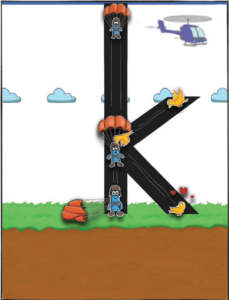
For example, when the letter k makes a diagonal stroke, the skydiver gets an unexpected kiss from a bird. That pairing increases the likelihood that students will recall the correct movement later.
Dopamine, Motivation, and Practice
Humor also activates the brain’s dopamine reward system. Dopamine is associated with motivation, habit formation, and long-term memory.
When students laugh:
- they stay engaged longer
- they are more willing to repeat the movement
- they experience less frustration
This matters because handwriting improves through accurate, repeated practice. If the task feels stressful or monotonous, students avoid it. If it feels enjoyable, they practice more and build stronger motor plans.
Humor Reduces Anxiety and Builds Confidence
Many students approach handwriting with hesitation, especially if they have struggled before. Humor lowers the emotional stakes. It creates a classroom environment where mistakes feel safe and practice feels manageable.
Shared laughter also increases social connection, which supports risk-taking and persistence. Students are more likely to try again after an error when the atmosphere is supportive and relaxed.
Why Humor Strengthens Motor Memory
Motor learning improves when students:
- focus their attention on the movement
- repeat the correct sequence
- attach meaning to the action
Humor supports all three. It highlights the critical stroke, provides a memorable cue for recall, and makes repetition more tolerable.
Final Thoughts
When learning includes humor, it can trigger laughter that makes students want to repeat the same practice activities over and over again. In handwriting instruction, where fluent writing is built through repeated, accurate practice, that willingness to re-engage is a powerful advantage. Over time, those repeated, meaningful movements become automatic. And when letter formation is automatic, students can shift their attention to spelling, sentence construction, and idea generation.