Executive Summary
Choosing the best handwriting program for kids is not simply a question of which program is most familiar, most widely used, or easiest to purchase. It is an instructional decision with implications for literacy, writing fluency, teacher workload, intervention needs, and student confidence.
A strong handwriting program should do more than help children produce neat letters on a workbook page. It should help students build automatic letter formation, so handwriting no longer consumes the cognitive resources needed for spelling, sentence construction, and written expression.
Several well-known programs address handwriting in meaningful ways. Handwriting Without Tears offers explicit, systematic instruction and strong teacher supports. Zaner-Bloser provides a traditional K–6 manuscript and cursive pathway with daily print and digital instruction. Fundations includes handwriting as part of a broader structured literacy program. D’Nealian is a script style designed to ease the transition from manuscript to cursive.
The key distinction is this: not all handwriting programs are organized around the same instructional logic. When the purchasing priority is early elementary handwriting automaticity, efficient lowercase instruction, reversal prevention, and manageable classroom implementation, Handwriting Heroes aligns especially closely with the criteria administrators should be using to evaluate handwriting instruction.
Why Handwriting Belongs in the Curriculum Conversation
Handwriting is sometimes treated as a minor skill, separate from literacy. In practice, it functions as a foundation for written output.
When letter formation is slow, inconsistent, or effortful, students may produce less writing than they are capable of composing. They may avoid written tasks, struggle to keep up, or require additional adult support. Teachers may see the impact in spelling, sentence writing, journals, written responses, and assessments.
The goal of handwriting instruction is not decorative penmanship. The goal is legible, efficient, automatic writing.
Administrators evaluating handwriting programs should therefore look beyond surface features such as workbook design or brand recognition. The more important question is whether the program offers students the most efficient path from letter formation to functional writing.
That makes scope, logic, and sequencing central to the purchasing decision.
Table 1: Research and Instructional Design
| Feature | Handwriting Without Tears | Handwriting Heroes | Zaner-Bloser | Fundations | D’Nealian |
|---|---|---|---|---|---|
| Primary purpose | Dedicated handwriting program 1 | Dedicated handwriting program | Dedicated handwriting program 2 | Integrated into a broader K–5 literacy program 3 | Dedicated handwriting program 4 |
| Letter order | Uppercase first 9 | Lowercase first | Lowercase/uppercase paired together 2 | Lowercase first 3 | Lowercase first |
| Initial letter groups | Uppercase, grouped by starting position and initial stroke: Frog Jump Capitals (F, E, D, P, B, R, N, M) · Starting Corner Capitals (H, K, L, U, V, W, X, Y, Z) · Center Starting Capitals (C, O, Q, G, S, A, I, T, J) 9 | Lowercase, grouped by shared motor plan: Skydivers (vertical strokes: l, t, k, i, j) · Bouncers (retrace strokes: b, h, r, n, m, p) · Cannon Pops (start like c: c, a, d, o, g, q) · Skiers (diagonal strokes: v, w, x, y) · Surfers (mixed strokes: s, u, f, e, z) | By shared stroke, taught as lowercase/uppercase pairs (e.g., Oo, Aa, Dd together) 2 | No dedicated grouping system; formation follows the phonics sequence 3 | Not grouped by motor plan; built around one continuous slanted stroke used for most lowercase letters 4 |
| Secondary letter grouping | Lowercase, grouped by starting point, stroke sequence, and height: Magic C (c, o, a, d, g, q) · Tall (l, t, k, h, b, f) · Short (i, j, r, p) · Other Curves (u, y, e) · Diagonals (v, w, x, z) · Bumpy (n, m) · Tricky (s) | Uppercase, categorized by similarity to lowercase formation: Double Trouble (C, O, S, V, W, X, Z) · Super Similar (B, F, H, I, J, K, L, P, T, U, Y) · Dangerously Different (A, D, E, G, M, N, Q, R) | N/A (single grouping approach) | N/A (single grouping approach) | N/A (single grouping approach) |
| Writing line system | Two lines: midline and baseline (no separate top line; capitals and tall letters extend freely above the midline) 1 | Three lines: sky (top line), clouds (midline), and grass (baseline), plus the dirt area below the baseline for descenders 8 | Three lines (headline, midline, baseline) | Four lines: sky line, dotted plane line, grass line, and worm line below the baseline for descenders | Three lines (baseline, midline, descender space), plus added diagonal guides to reinforce the slant |
| Motor learning approach | Blocked: one letter taught and drilled before the next | Variable: letters that share a motor plan are taught together, with spiral review built into every lesson | Blocked, by cluster: a small group of letters (e.g., Oo, Aa, Dd) is taught and drilled together before the next cluster 2 | Blocked introduction (2–3 letters/sounds per week), with spiral review of prior letters 3 | Blocked: letters are practiced individually in sequence 4 |
| Directional cues | Starting dots (corner or center) plus directional arrows and short verbal phrases tied to letter families 1, 9 | Character-driven stories map directly to each stroke, with movement lines that show the letter’s path 7 | Directional arrows on letter models plus simplified verbal stroke descriptions 2 | Verbal cues paired with skywriting and tracking; no dedicated arrow or dot system 3 | Directional arrows on letter models plus stroke-modeling animation videos 4 |
| Reversal prevention | Not the primary organizing logic | Designed to reduce reversals by separating commonly confused letters into distinct movement families | Not the primary organizing logic | Not the primary organizing logic | The continuous stroke’s fewer pencil lifts are credited with cutting down on common reversals 4 |
| Word writing / transfer | Second half of kindergarten, after capitals are taught and lowercase instruction begins 1, 9 | Early in kindergarten: lowercase groups run weeks 1–5, with three-letter word writing beginning week 6 7 | In kindergarten, after each letter cluster, via built-in application practice 2 | From the start of kindergarten, since handwriting is tied to dictation and encoding 3 | In kindergarten, once lowercase and uppercase letters are taught 5 |
The major programs differ less in whether they value handwriting and more in how they organize handwriting instruction. Handwriting Without Tears offers a familiar, explicit, OT-informed approach with strong teacher support. Zaner-Bloser provides a comprehensive traditional manuscript and cursive pathway, including digital resources and a clear fluency message. Fundations is strong for districts seeking structured literacy, but handwriting is one component of a larger reading and spelling system. D’Nealian addresses a specific historical challenge: the transition from print to cursive.
Handwriting Heroes is distinct because the handwriting sequence itself is organized around the criteria most closely tied to early writing efficiency: lowercase-first instruction, shared motor patterns, clear spatial guidance, and early transfer into real word writing.
For administrators, this distinction matters. A handwriting program should not simply cover letters. It should help students understand how letters work.
Table 2: Classroom Implementation
| Feature | Handwriting Without Tears | Handwriting Heroes | Zaner-Bloser | Fundations | D’Nealian |
|---|---|---|---|---|---|
| Multisensory instruction | Hands-on materials for fine and gross motor skills, songs, and video demonstrations 1 | Movement, songs, animations, air writing, and finger tracing | Print and digital multimodal instruction 2 | Multimodal structured-literacy routines 3 | Can be supplemented with stroke-modeling videos 4 |
| Teacher prep | Scripted guides, built-in differentiation and progress monitoring 1 | Minimal prep: guided lessons delivered through videos, workbooks, and printable resources 7 | Student/teacher editions plus digital resources 2 | Full scope and sequence, scaffolding, and professional learning 3 | Simple Teach, Model, Practice, Evaluate structure 4 |
| Progress monitoring | Whole-class Screener of Handwriting Proficiency, usable in an RTI framework 1 | Quick Handwriting Assessment: pre/post results, data tracking 7 | Self-assessment via 4 Keys to Legibility 2 | FUN HUB dashboard: practice, data tracking, reporting 3 | Not a defining feature of the method |
| Time required | Varies by implementation | 15 min/day 7 | 15 min/day 2 | 20–30 min/day 3 | Varies by curriculum used |
Implementation is often the difference between a curriculum that looks strong on paper and one that works across classrooms.
Administrators should consider whether teachers can use the program with fidelity, whether lessons fit into the school day, whether students remain engaged, and whether the program provides enough structure for general education teachers, not only specialists.
This is where purchasing decisions often become clearer.
Handwriting Heroes occupies a different space. It is not trying to be a full structured literacy program. It is not primarily a traditional print-to-cursive pathway. It is a targeted handwriting program built around the specific problem administrators are often trying to solve: how to help young students form letters automatically, transfer those skills into writing, and reduce preventable handwriting difficulties before they require remediation.
Why Lowercase-First Deserves Administrative Attention
Many handwriting programs historically begin with uppercase letters. That choice can appear developmentally reasonable because uppercase letters are often visually simpler and easier to recognize.
However, classroom writing is dominated by lowercase letters. Uppercase letters are used in only about 2% of writing 6. Students read lowercase letters, spell with lowercase letters, write words with lowercase letters, and compose sentences with lowercase letters. Delaying focused lowercase instruction can delay the skills students need most for authentic writing.
This is not a minor sequencing detail; it shapes how quickly students reach authentic writing.
Lowercase-first instruction does not mean uppercase letters are unimportant. It means the instructional sequence prioritizes the forms students use most frequently and need most urgently for written expression.
This is one of the clearest ways Handwriting Heroes differs from more traditional approaches. Its sequence begins where functional writing begins: lowercase letter formation.
Why Program Structure Matters: Phonics Integration
Some programs fold handwriting instruction into a broader phonics program. Fundations is a clear example: handwriting is one strand within a much longer phonics scope and sequence 3.
That structure can serve a district’s broader literacy goals well. But it also means explicit letter-formation practice competes with decoding, encoding, and spelling instruction for classroom time, which can delay consistent, focused practice with the physical skill of handwriting itself.
Why Simultaneous Uppercase and Lowercase Instruction Can Overwhelm Learners
Some programs teach the uppercase and lowercase forms of a letter together. Zaner-Bloser’s paired approach is a good example 2.
Asking a student to hold two visual and motor patterns in mind for the same letter at once asks a great deal of a young learner. For some students, it may slow mastery of either form rather than reinforcing both.
Why Letter Grouping Matters
Many programs group letters. What matters more is how they group them.
Grouping matters because young children are not simply learning what letters look like. They are learning where to start, which direction to move, how to control size, how to place letters on lines, and how to retrieve those motor plans quickly enough to write words and sentences. Letters should not be treated as 26 unrelated shapes; they should be taught through patterns students can recognize, repeat, and generalize.
Some programs group by visual features, some start with uppercase, and others follow a print-to-cursive progression or embed letter formation within a phonics sequence.
Handwriting Heroes groups lowercase letters by shared motor plans. This distinction is important because handwriting is a motor task, not only a visual task.
When students learn letters through shared movement patterns, they can apply one motor plan across multiple letters. That supports generalization and spares students from learning each letter as a separate, isolated form.
This is especially important for students who struggle with reversals, inconsistent formation, slow writing, or poor carryover from handwriting pages into classroom writing.
Why Directional Cues Matter
Every program gives students some way to know where a stroke starts and which way it moves. Most rely on static visual cues: an arrow printed on the letter, a dot marking the starting point, or a short verbal phrase a student recites while writing.
Handwriting Heroes takes a different approach. Each letter’s stroke sequence is embedded in a short story, with specific story elements matched to specific parts of the stroke. The direction of movement isn’t just marked; it’s narrated and reinforced by movement lines that visually trace the path as the story unfolds. That gives students a memorable, logical reason for why the pencil moves the way it does, rather than a cue to simply follow.
The practical question is how well a cue transfers from guided practice to independent writing. A static arrow or dot only works as long as it’s visible on the page. A story a student has internalized travels with them.
Why Writing Lines Are More Than a Design Choice
Writing lines are not just a visual preference. They are a teaching tool.
Young writers must learn that some letters are tall, some are short, and some descend below the baseline. A top, middle, and bottom structure gives students a concrete way to understand those differences.
Guideline systems give students a consistent frame of reference for where to start and stop each stroke.
A reduced line system may appear cleaner, but most young students need more spatial information, not less. The key is whether the line system helps students place letters accurately and transfer that placement to everyday writing.
A Professional Recommendation
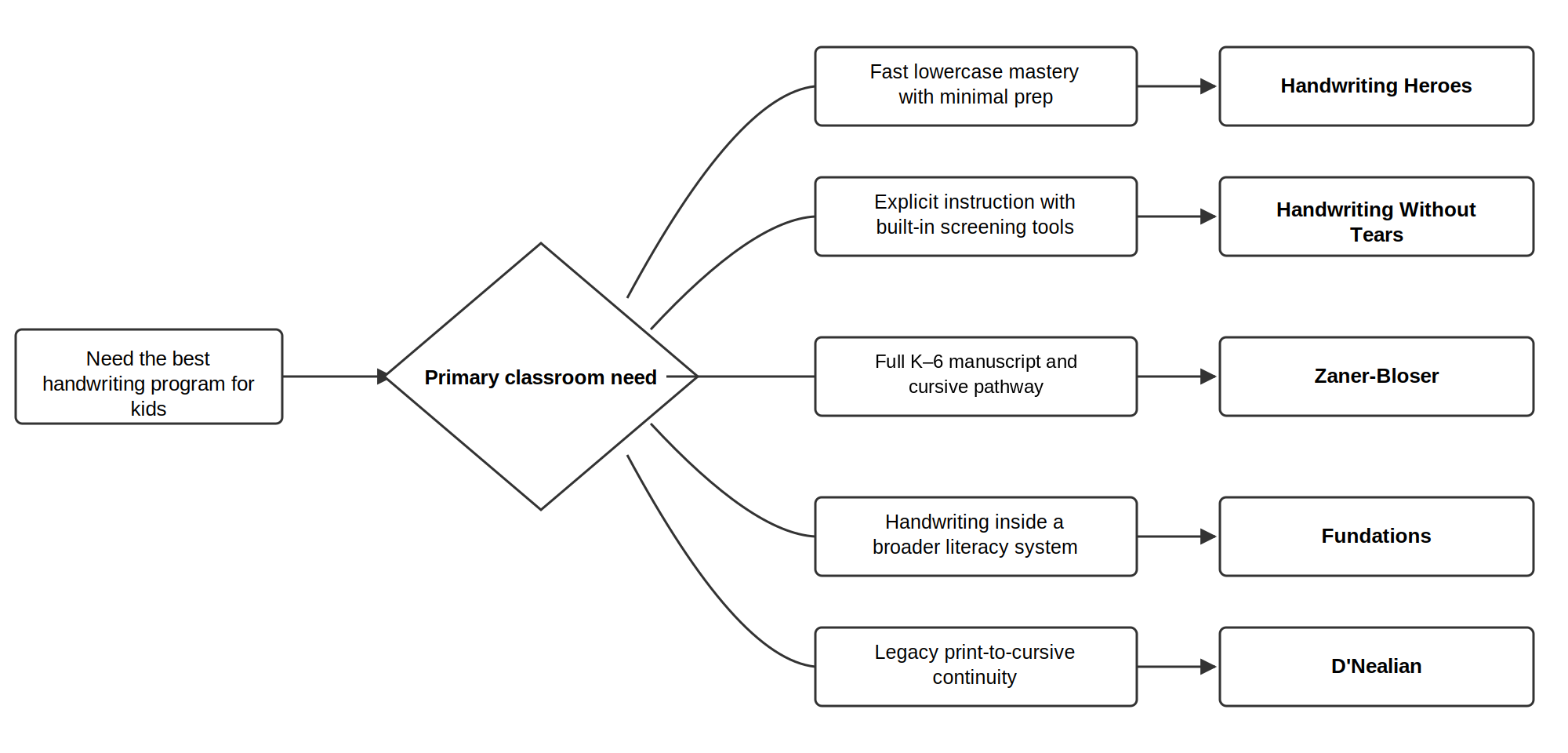
For administrators comparing handwriting options, the decision should not be framed as “Which program is most popular?” or “Which program have we always used?”
The better question is:
Which program best aligns with how young children build automatic, functional handwriting?
Handwriting Without Tears, Zaner-Bloser, Fundations, and D’Nealian each have a defined place in the handwriting or literacy landscape.
A district prioritizing a full structured literacy program will find Fundations belongs in the conversation. One prioritizing a traditional K–6 manuscript-to-cursive sequence will find Zaner-Bloser a serious option. Districts looking to ease the print-to-cursive transition will find D’Nealian purpose-built for that. And those wanting a familiar, explicit handwriting curriculum will find Handwriting Without Tears well established.
For early elementary handwriting instruction that is lowercase-first, movement-based, spatially clear, engaging for students, manageable for teachers, and designed to move quickly into real word writing, Handwriting Heroes offers a particularly strong match.
That conclusion does not require exaggerated claims. It follows from the instructional design.
Sources
- Learning Without Tears, lwtears.com/hwt
- Zaner-Bloser Handwriting, zaner-bloser.com/handwriting/zaner-bloser-handwriting/index
- Wilson Language Training, Fundations, wilsonlanguage.com/programs/fundations
- D’Nealian Handwriting Curriculum, Savvas, savvas.com/solutions/supplemental/supplemental-programs/dnealian-handwriting
- D’Nealian Handwriting Student Edition, Rainbow Resource product descriptions, rainbowresource.com/037802.html
- Berninger, V. W., & Wolf, B. J. (2016). Teaching Students with Dyslexia and Dysgraphia: Lessons from Teaching and Science (2nd ed.). Brookes Publishing.
- Leveraging Science to Transform Handwriting Practices, Handwriting Heroes white paper, © 2024
- Teaching Handwriting: Don’t Forget Your Lines, Handwriting Heroes blog, handwritingheroes.org/2017/03/09/teaching-handwriting-dont-forget-lines/
- Handwriting Without Tears Letter Order, The OT Toolbox, theottoolbox.com/handwriting-without-tears-letter-order/