An independent case study found first graders mastered 18 additional letters in five weeks
When schools evaluate a new curriculum, one of the first questions administrators ask is whether the program has evidence behind it. The Every Student Succeeds Act (ESSA) gives schools a shared framework for answering that question. Programs are rated on a four-tier scale, and schools using federal funds are often required or strongly encouraged to choose programs that meet one of the top three tiers.
Handwriting Heroes has earned an ESSA Level 3 (Promising Evidence) designation, based on an independent case study conducted by LXD Research, a third-party education research firm. This article summarizes what the study found and what it means for schools considering the program.
The Study
The case study followed two cohorts of first graders at a small rural elementary school in Garrett County, Maryland. Students were assessed on lowercase letter formation before and after completing the Handwriting Heroes curriculum, which teaches all 26 lowercase letters in five weeks by grouping them according to their common strokes.
In Year 1, the teacher introduced the program mid-year, in April, after teaching most of the year without a formal handwriting curriculum. In Year 2, she began the program in September, using the pretest to establish students’ starting point at the beginning of first grade.
Key Findings
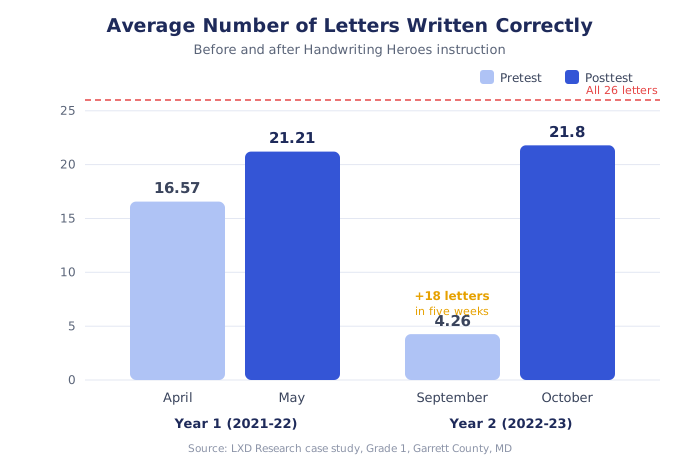
The Year 2 results tell the clearest story. Students began September writing an average of 4.26 letters correctly. Five weeks later, they averaged 21.8, a gain of roughly 18 letters. This corresponds to an effect size of 3.19 (Cohen’s d, a standard yardstick for how big a change is). For context, researchers usually consider anything above 0.8 a large effect, so 3.19 is an unusually strong result for an educational intervention. One student progressed from writing a single letter correctly to mastering all twenty-six by the end of the program.
Year 1 students also made meaningful gains despite starting mid-year with most letters already partially learned. Average accuracy grew by 17 percent, and half of the students improved their accuracy by 30 percent or more.
| Year | Assessment | Mean | N | Effect Size |
|---|---|---|---|---|
| Year 1 | Pretest (April) | 16.57 | 14 | Cohen’s d = 0.67 |
| Year 1 | Posttest (May) | 21.21 | 14 | |
| Year 2 | Pretest (September) | 4.26 | 13 | Cohen’s d = 3.19 |
| Year 2 | Posttest (October) | 21.8 | 13 |
A Lesson for Implementation
The difference between the two years points to a practical takeaway: timing matters. When the program ran at the start of the school year, before students had months to practice inefficient letter formations, growth was dramatically stronger. Schools adopting Handwriting Heroes will see the greatest benefit by scheduling the five-week curriculum early in the fall.
Study Limitations
As with any case study, the findings come with limitations. The sample was small, drawn from a single rural district, and focused on first grade only. The Year 1 pretest was administered in April following a mid-year curriculum change, which may have affected comparisons between cohorts. These are the kinds of constraints ESSA Level 3 is designed to accommodate: promising evidence from a well-conducted study, with larger-scale research as the natural next step.
Independent Analysis
The study was independently analyzed and written by LXD Research, a division of Charles River Media Group specializing in the evaluation of educational programs. The full case study, along with the program’s logic model and research base, is available in the Handwriting Heroes ESSA Evidence Packet.
Handwriting Heroes has also earned the Research-Based Design Product Certification from Digital Promise. Read about that recognition in Handwriting Heroes Earns Research-Based Product Certification.
See the Program Behind the Results
Handwriting Heroes teaches all 26 lowercase letters in five weeks through animated stories, songs, and multisensory practice. Explore the curriculum at www.handwritingheroes.org or contact cheryl@handwritingheroes.org for questions about bringing the program to your school.
About the Author: Cheryl Bregman, OT, M.S.
Cheryl Bregman is an occupational therapist with 25+ years helping children overcome handwriting challenges and the founder of Handwriting Heroes. She holds a Master’s in Technology in Special Education from Johns Hopkins University.